Alle berichten van Thijn

“Dreams of Dali”- Walk inside a Dali painting

Virtual tour in schilderij Salvador Dali – “Archeological Reminiscence of Millet’s Angelus”

“One day it will be officially admitted
that reality is an even greater illusion
than the world of dreams”
Salvador Dali

“A true artist is not one who is inspired,
but one who inspires others”
Salvador Dali


“Dreams of Dali”, the 360-degree video , drops you into the world of Dalí’s
1935 canvas “Archeological Reminiscence of Millet’s Angelus” an homage to an
earlier work (Jean-François Millet’s painting, “The Angelus”) which enjoyed
enormous popularity during Dalí’s youth. The late 19th century painting depicts
a peasant couple standing in a field with their heads bowed in prayer. For many
it was a sentimental work, but for Dalí’ it was troubling, with layers of hidden
meaning, which he explored through daydreams and fantasies.”


As the artist himself put it, “I surrendered myself to a brief fantasy
during which I imagined sculptures of the two figures in Millet’s ‘Angelus’
carved out of the highest rocks.” His formidable imagination converted
that mid-19th-century image of rural hardship and piety into the moonlit
desert landscape through which “Dreams of Dalí” flies you.

Link naar bron:
www.openculture.com

Bekijk de prachtige 3D-animatie “Dreams of Dali” op YouTube:

Proust en Vermeer – Petit Pan de Mur Jaune

“Le véritable voyage de découverte
ne consiste pas à chercher
de nouveaux paysages,
mais à avoir de nouveaux yeux”
Marcel Proust


Marcel Proust was een groot bewonderaar van Vermeer, geïnspireerd
door de artikelen van de kunstcriticus Jean-Louis Vaudoyer.
Beroemd is de passage in zijn meesterwerk “A la Recherche du
Temps Perdu” over de schrijver Bergotte die staande voor het
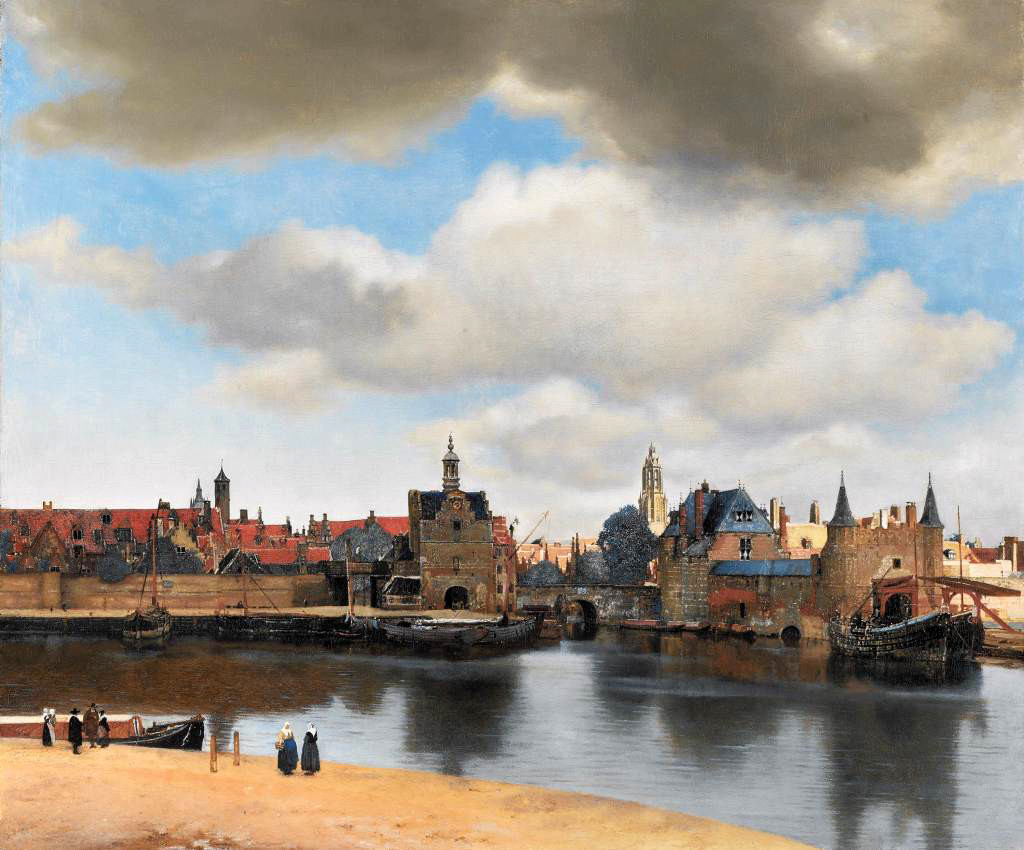
Gezicht op Delft van Vermeer in vervoering raakt over een geel
muurvlakje: “un petit pan de mur jaune”.

Hij voelt dat als hij zijn eigen leven in een hemelse
weegschaal zou afwegen tegen het “petit pan de mur jaune de Ver Meer”,
hij zonder aarzelen de balans zou laten doorslaan naar dat ene gele
muurvlakje van Vermeer……

“……Mais un critique ayant écrit que dans la Vue de Delft de Ver Meer
(prêté par le musée de La Haye pour une exposition hollandaise),
tableau qu’il adorait et croyait connaître tres bien, un petit pan de
mur jaune (qu’il ne se rappelait pas) était si bien peint qu’il était,
si on le regardait seul, comme une précieuse oeuvre d’art chinoise,
d’une beauté qui se suffisait à elle-même…….Enfin il fut devant le
Ver Meer…..où, grâce à l’article du critique, il remarqua pour le
première fois des petits personnages en bleu, que le sable était rose,
et enfin la précieuse matière du tout petit pan de mur jaune…….
Dans une céleste balance lui apparaissait chargeant l’un des pla-
teaux sa propre vie, tandis que l’autre le petit pan de mur si bien
peint en jaune. Il sentait qu’il avait imprudemment donné la première
pour le second…….”

“Espacios Occultos” – Jose Manuel Ballester

“Become totally empty,
Quiet the restlessness of the mind,
Only then will you witness
Everything unfolding from emptiness”
Lao Tze


All of the paintings above may seem familiar to you, but they lack a
certain something… In his “Hidden spaces“ (Espacios occultos) image
series, Spanish artist José Manuel Ballester removes the people from
classical paintings, revealing unnoticed hidden spaces (hence the name)
and objects.
Combining modern technologies with classical art, he invites viewers
to look at these masterpieces from a new angle and reinterpret the
stories we think we already know. The removal of people creates a
different effect in each painting – in some, you can see the traces
of a tragedy or the aftermath of a drama in the objects left behind,
while others simply leave you wondering where everybody’s gone.
Each new-found empty space is open for interpretations and discoveries.

Bron:

website Jose Ballester

Het “leeg schilderen” van meesterwerken in de schilderkunst is al
vaker gedaan: door de Amerikaanse schilder George Deem en vóór hem
door de Italiaanse kunstenaar Riccardo Lumaca in zijn boekje
“Tre Vite Parallele di Johannes Vermeer”.

“We become aware of the void
as we fill it”
Antonio Porchia

Vooral Vermeer interieurs behouden hun schoonheid en serene uitstraling,
naarmate ze leeg worden geschilderd.
Bv. “Het Concert” uit het Isabella Stewart Gardner Museum in Boston.
Deze fotomontages zijn van mijn eigen hand:


Gabriël Metsu – Close to Vermeer

“To write a letter is human,
To receive a letter is divine !”
Susan Lendroth


In de National Gallery of Ireland in Dublin bevinden zich twee
pendant-schilderijen van Gabriel Metsu (1629-1667):
“A Man Writing a Letter” en “A Woman Reading a Letter
with her Maid”, beiden rond 1663.
Het oeuvre van Gabriël Metsu is zeer wisselend in
stijl en kwaliteit, maar in zijn beste momenten komt hij van al
zijn tijdgenoten nog het dichtst in de buurt van Vermeer.

Kijk ook op YouTube dit filmpje met Adriaan Waiboer, de curator
of Northern European Art van de National Gallery of Ireland, Dublin:
Behind the Painting: Vermeer’s “Lady writing a Letter, with her Maid”:

Baron van Swieten: Vermeer en Mozart

“Forgive me, majesty. I am a vulgar man.
But I assure you, my Music is not”
Wolfgang Amadeus Mozart

Baron Gottfried van Swieten (1733, Leiden –1803, Vienna) was a wealthy
“Freiherr”, who served the Austrian Empire during the 18th century.
He was an enthusiastic amateur musician and is best remembered today
as the patron of several great composers of the Classical era,
including Wolfgang Amadeus Mozart

In his art collection, he owned a Vermeer, the famous “Art of Painting”,
which he inherited from his father. At the time it was not known that
the painting was by Vermeer, but wrongly attributed to Pieter de Hoogh.
By 1782, van Swieten had invited Wolfgang Amadeus Mozart to visit him
regularly, in order to inspect and play his manuscripts of works by Bach
and Händel, which he had collected during his diplomatic service in Berlin.
As Mozart wrote to his father Leopold (10 April 1782):
“I go every Sunday at twelve o’clock to the Baron van Swieten, where
nothing is played but Händel and Bach. I am collecting at the moment
the fugues of Bach………”
Bron: Wikipedia

Het lijkt heel aannemelijk dat Mozart het meesterwerk van Vermeer
“Die Malkunst” bij zijn bezoeken aan de villa van Baron Gottfried van
Swieten met eigen ogen gezien heeft.

“Dies Bildnis ist Bezaubernd Schön”, een prachtige aria uit misschien wel
Mozart’s mooiste Opera, Die Zauberflöte, zou heel wel door het zien van
Vermeer’s “Malkunst” bij Van Swieten geïnspireerd kunnen zijn.

Een opname uit 1983 van Francisco Araiza met de aria “Dies Bildnis ist
bezaubernd schön” met libretto-tekst van de aria staat op YouTube:

“Dies Bildnis ist bezaubernd schön”
Tamino’s aria, Die Zauberflöte,
Wolfgang Amadeus Mozart.

Dies Bildnis ist bezaubernd schön,
Wie noch kein Auge je geseh’n!
Ich fühl’ es, ich fühl’ es, wie dies Götterbild
Mein Herz mit neuer Regung füllt.
Mein Herz mit neuer Regung füllt !
Dies’ etwas kann ich zwar nicht nennen,
Doch fühl’ ich¹s hier wie Feuer brennen.
Soll die Empfindung Liebe sein?
Ja, ja, die Liebe ist’s allein.
Die Liebe, die Liebe,
Die Liebe ist’s allein !
O, wenn ich sie nur finden könnte!
O, wenn sie doch schon vor mir stände!
Ich würde, würde, warm und rein,
Was würde ich?
Ich würde sie voll Entzücken
An diesen heissen Busen drücken
Und ewig wäre sie dann mein.
Und ewig wäre sie dann mein,
ewig wäre sie dann mein,
ewig wäre sie dann mein !